VISIBLE
Born Ruth Wajsberg in Warsaw, the exact date of her birth is not known. Different sources report it as being between 1929 and 1933.
Ruth was the only child of Moshe Wajsberg, an accountant and local government official, who was also an artist (and a non-practicing Jew), and his wife, Anna, an underwear designer.


When the Nazis invaded Poland in 1939, the family were evicted from their home. They were given just fifteen minutes to pack. Anna said to an SS man, “You wear a black uniform but surely you don’t have a black heart?”
The soldier promptly punched her on the nose. Ruth was shocked. It was the first time she had experienced Nazi violence.


The family was sent to the Warsaw Ghetto. It was created in late 1940 with one and a half million people crammed into a space just 3.5 square miles in size.


In 1942, Moshe arranged for Ruth and her aunt, Lola, to work in a Jewish-owned leather factory outside of the Ghetto walls. Ruth was nine years old.
They were taken once a week to a bathhouse – and they took the opportunity to escape when their two guards went for a cigarette. Lola and Ruth simply ran away, ripping off the yellow stars from their sleeves. “We knew that if we were noticed, we would be shot. But if we stayed, we knew we would die anyway.”

Ruth spent most of the rest of the war pretending to be Irene Slabowska, a young Polish Catholic girl, living in Warsaw. She was saved by the fact her family had spoken Polish at home (not Yiddish, which was the norm amongst Jewish families).
She prayed every night, “Like a good Catholic girl – You never knew who was watching.”
In later years, Ruth said, “I did my best acting when I was twelve years old.”
Ruth never heard of her parents again. She always believed they had died in Treblinka Concentration Camp, but could never prove it.

Later, Ruth said, “Some people want to know exactly what happened to their families, but I don’t because I feel part of them is still with me. I have enough imagination to know what happened to them and I just hope it happened quickly.”
When she was thirteen, Warsaw was evacuated, after the Uprising. As the “Little Catholic girl”, she was sent as a Prisoner-of-War (POW) to Germany. Kept in Detmold Prison Camp, conditions were poor, but Ruth admitted later on, “It was not quite as bad as a concentration camp.” However, she said she had still been subjected to torture.


Ruth was then put on a POW train to Auschwitz. On the way, at Essen, the train was bombed by American planes. The German guards panicked and ran away.
Ruth forced the door open and escaped with her Aunt Lola. They was taken in by local farmers (who thought they were Catholics) and spent the end of the war working on the farm. Ruth’s job was to milk the cows.
As the German army collapsed, two young soldiers sought refuge in a barn. Allied soldiers came looking for them. “They asked us if anyone was hiding there. I saw the German farmer’s wife look at us. I thought of everything we had been through, the pretending, the hiding. They were only boys. We couldn’t betray them. My aunt and I said nothing.”
At the end of the war, Aunt Lola, worked as a waitress at an RAF camp. One morning, she served the commander eggs and bacon for breakfast. He told her he couldn’t eat the bacon as he was Jewish. For the first time in the war, Lola confessed she was too.
The commander asked her if she knew of any Jews still in hiding as he had been charged with rescuing them.
Consequently, Ruth and Lola were sent to Britain as refugees. Ruth was sixteen. By now, she was fluent in Polish, Yiddish, English, German and Italian.

“The United Kingdom is the country that took me in after the war. To me, it’s my Motherland. Out of all the places we have lived, London is the place I don’t feel a foreigner.”
Recounting the eggs and bacon incident, Ruth said, “My life consists of many strange coincidences – and this was the start of incredible luck.”

In England, Ruth learned that, apart from her aunt, just one cousin had survived the war. Every other relative had died. “My whole life changed. I lost everyone.”
Whilst searching for work in London, Ruth took up dancing.
She met chemist Michael Posner at a dance in London. They were married in 1950 and had one son called Jeremy.
Ruth became a dancer and choreographer at the London Contemporary Dance School. She told her students that whether dancing or acting, “You emphasise your eyes.”

Ruth performed a daily, lengthy beauty regime. “Putting on eye-makeup is like having a shower – it cleanses me.”
She was also on the first billboard that challenged anti-semitism in Britain.

In the early 1970s, her husband Michael was sent to New York to work for UNICEF. Ruth went with him and began teaching Physical Theatre at the Juilliard School in the city. Simultaneously, she worked at Brandeis University in Boston.


Ruth also began to train as an actor, gaining an MA in Theatre Arts from Hunter College.

Nine years later, the Posner family returned to England, living in Belsize Park, London.


Ruth became a peripatetic teacher of Theatre Arts, working at institutions such as the London Academy of Music and Dramatic Art, RADA and the Central London School of Speech and Drama.

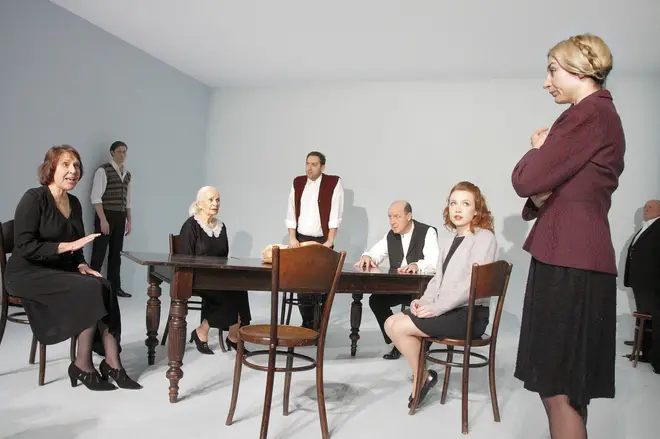
Ruth was offered the opportunity to tour Germany in a play about the horrors of the Holocaust, performed in universities. Her friends were shocked when she agreed to go. “Yes, I will go to Germany. It’s a new generation.”
After one performance, the Chancellor of the university came up to her and shamefully admitted he had been part of Hitler Youth, proud to wear his uniform as an eight-year old boy. He said he had no idea at the time what was really going on. He thanked Ruth for spreading the message and for helping to make the world a better place.
Ruth made her TV debut in 1990 in ‘Making News’ and went on to appear in many other programmes such as Love Hurts, The Ruth Rendell Mysteries, Bramwell, The Bill and in the first series of Count Arthur Strong. Ruth spent sixteen years working on the hospital drama ‘Casualty’.


Ruth also appeared in many films, most notably ‘The Football Factory’.

She performed in many plays, working with the Royal Shakespeare Company and performing in several West End musicals.


Ruth and Michael were devastated when their son Jeremy died at the age of thirty-seven.
Ruth wrote a play about her early life, entitled ‘Who Do We Think We Are?”
She said, “I think of it as a kind of exorcism – but I don’t want to be remembered as the woman who always plays Holocaust survivors. I long for roles in light-comedy.”
Ruth also created an acting company called ‘Visible’ (the opposite of invisible). To join it, you had to be over sixty.


Ruth also wrote her autobiography, called ‘Bits and Pieces of My Life’. She said Jewishness was not relevant to her until the Nazis invaded Poland.
Ruth added that she could still hardly utter the words, “I am a Jew”, as secrecy was so ingrained in her.


Her relationship with husband Michael remained very strong. “He is a very wise and intelligent man.” Ruth said he always supported her in everything she did – “But then again, he’s always had female bosses.”


She spent her later years educating young people about the Holocaust. Ruth reflected, “Now when I talk about it, it seems like I’m describing my role in a play.”
Ruth began each talk by saying, “This evil was the worst thing of humanity. I don’t like to talk about it, but I just have to tell you.”
She was recognised in the 2022 New Year’s Honours list for her, ‘Services to Holocaust Education’.


Both Ruth and Michael’s health began to fail. She could not walk and he began to lose his eyesight. Ruth told a friend, “We’ve had enough. We’re ready to go. We don’t want to just exist. And that’s what we’re doing. Just existing.”

In 2025, Ruth died alongside her husband Michael (aged 97), in an assisted suicide at the Pegasos Clinic, near Basel in Switzerland. She sent a final letter to all of her friends. ‘So sorry not to have mentioned it, but when you receive this e-mail we will have shuffled off this mortal coil. The decision was mutual and without any outside pressure. We had lived a long life together – for almost seventy-five years. There came a point when failing senses, of sight and hearing and lack of energy, was not living, but existing – that no care would improve. We had an interesting and varied life except for the sorrow of losing Jeremy, our son. We enjoyed our time together, we tried not to regret the past, live in the present and not expect too much from the future.
Much love, Ruth and Mike’.
A friend, defending their decision, said of the couple, “Life wouldn’t have been anything at all to them separately. He’d been in hospital earlier this year and she was absolutely beside herself. They had a good life, so why spoil it?”
Actress Sonja Linden, co-founder of Visible, called Ruth, “The most vibrant, amazing woman.”

Sonja added about Michael Posner, “He was a remarkable, clever, intellectual man.”
The Holocaust Education Trust said of Ruth, “She hoped that the leaders of tomorrow would learn the lessons of the past.”


RIP – Ruth’s Incredible Performance