
THE MAN WITH FOUR NAMES AND THREE LIVES
Born in Rome, Mario’s parents were Pacifico Fiorentini, a Jewish accountant who specialised in bankruptcies, and Maria Moscatelli.
Mario was born just four days after the decisive Battle of Vittorio Veneto, which ended the First World War.


His mother had come to the city from the rural village of Cittaducale in the Lazio region, looking for work, when she met Pacifico.
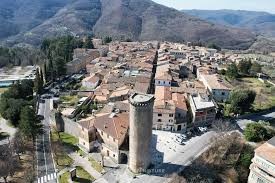
Pacifico was Jewish but Maria was not. Mario briefly considered converting to Judaism but abandoned the idea when told he would have to be circumcised.
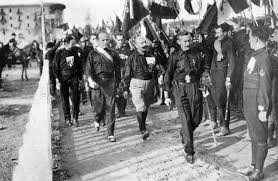
Aged just four years old, Mario witnessed the ‘March on Rome, where the Fascist Party, led by Benito Mussolini, seized power. He recalled, “Disgusting and grotesque images.” He never forgot this and was always a fervent anti-fascist.


His father used to take Mario to classical music concerts, and this became one of the passions of his life.
Mario went to University in Rome and became actively involved in theatre, cinema and the graphic arts. His theatre group included many people who went on to be Italy’s leading actors in later years.

Mario met Lucia Ottobrini at a classical concert. She was accompanied by her sister, Delia. Mario was really impressed that Lucia could speak fluent French. Lucia said later that she knew instantly that Mario was the man she was going to marry.

Mario joined the Communist Party whilst he was at university as a response to the Racial Laws of 1938.
Mussolini had never shown any anti-semitic inclination, until, in an effort to impress Adolf Hitler, he suddenly, and unexpectedly, unleashed a raft of racist propaganda and anti-Jewish laws.


In June 1940, Italy, under dictator Benito Mussolini, joined the Second World War on the side of the Germans – the ‘Axis’. They fought military campaigns in Greece and North Africa – both of which failed spectacularly.


Mario was called up to the army but had been sick in bed for months with enterocolitis – so he got exemption.
In July 1943, the Allies invaded Sicily and began fighting their way up Italy. Winston Churchill called the country, “The soft underbelly of Europe.”


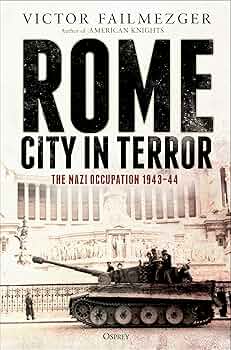
Germany abandoned its alliance with Italy and invaded the country from the north, advancing as far south as Rome.
Mario remembered an eerie silence descending over the city as the Nazis captured it.
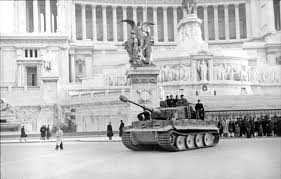
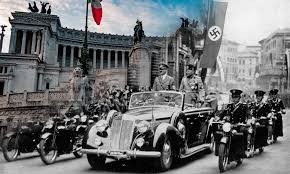
As this was happening, Mario joined the ‘Arditi del Popolo’ (Action of the People) with his friend, Antonello Trombadori. They were partisans determined to rid Italy of Fascism (and Nazism) and were part of the Italian Resistance..
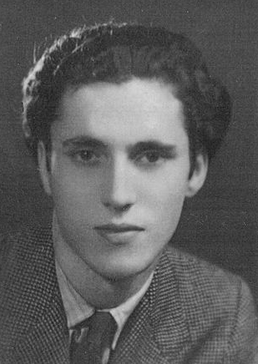


On the 9th September 1943, Mario fought with the ‘Action Party’ against the Nazis at the Battle of Porta San Paolo.
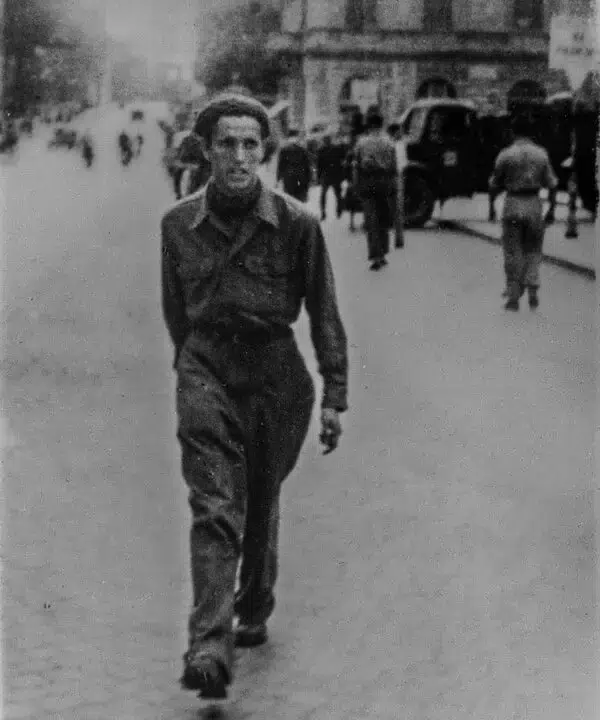

Afterwards, Mario helped form the GAP (Patriotic Action Groups), along with Carlo Ascane and Carlo Salinari, and was appointed commander.
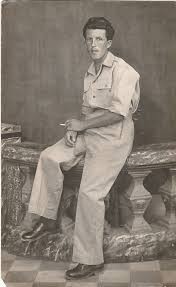

Mario and Salinari led a partisan cell together. Mario’s code-name was ‘Giovanni’ (although he had two other pseudonyms). He became a noted guerrilla fighter.
Mario was joined in his GAP cell by girlfriend, Lucia. She was just nineteen years old and was given the code name ‘Maria’. They were both known as ‘Gappistas’.


Lucia always carried their guns (Barettas) in her handbag. “She was a better shot than me.”
Mario realised they were taking huge risks. “Lucia and I trembled with fear, both of us. We fought the whole war together, hand-in-hand.”
The cell planned the assassination of the Minister of the Interior, Salo Guido Buffarini Guidi, and senior Fascist politician, Francesco Maria Barracu, as they ate at a restaurant in Piazza Navona. The attack was called off at the very last moment when the partisans were already in position.


Shortly afterwards, the cell killed three RSI (Nationalist) soldiers near the Palazo Braschi.
At one point, they were nearly betrayed. Mario was making bombs in a safe house with some other partisans. He left with another commander. A few minutes later, the SS raided the building.
Mario learned everybody left inside had been tortured and then executed. He realised somebody within his organisation was an informer.

For a while, he lost trust in his comrades, but then realised he could not work alone – you had to rely on others. “Fortunately, the population was on our side and showed solidarity with us…If we had them against us, many of us would have been captured.”
Throughout all of this, Mario was staying with his parents. He slept with bombs under his bed.
Then came the big round-up of the Jews in Rome.
Soldiers raided the house and arrested his parents. However, they neglected to search the rest of the house, so Mario, who was upstairs, was able to escape over the rooftops.
His parents were taken to military headquarters, then to Regina Coeli prison and finally the Roma Ghetto. They were supposed to be transported to Auschwitz concentration camp, but his mother bribed a guard with the family jewels and they both managed to escape, taking refuge with her sister.

Meanwhile, the next assassination attempt Mario was involved in, was on the German military commander in Rome, General Stahel. He was giving a speech at Teatro Adriana Square. A bomb was put under the stage, but it failed to go off.

The cell then killed a German officer who was carrying some important documents. These gave the Italian Resistance vital information.
One day later, December 18th1943, the cell bombed the Barberini Cinema, frequented by German soldiers. Eight of them were killed and many more wounded.
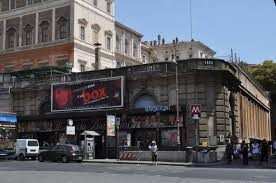
Throughout all of the resistance action, Mario made it clear they would only attack the enemy in uniform. He was continually shocked by the cruelty of the Nazis in Rome.
On Boxing Day 1943, Mario cycled along the banks of the River Tiber, up to the Regina Coeli prison, where his parents had been held. Despite it being freezing cold he was sweating because of fear.
He timed it so there was a changing of the guard – and he threw a bomb. “I was alone and in front of me was a squad of Germans armed to the teeth.”
Seven Nazis were killed with many others injured. Other German soldiers shot at him from the prison windows, but Mario managed to escape on his bike.

“I was pedalling like an obsessive and I reached the end of the bridge at full speed.” In addition to avoiding bullets, he was nearly hit by a black tram.
Mario disappeared into a warren of surrounding streets and hid in a friend’s bookshop, figuring it would be the last place the Nazis would hunt for an assassin.
The following day Nazi authorities banned the use of bicycles in occupied Rome.
In March 1944, the cell bombed a procession of Fascists through Rome, killing three of them. The march was totally disrupted but all of the partisans, including Mario, group escape successfully.
From his hiding place at his Aunt’s house, Mario noted that an SS Police Division marched past at precisely the same time every single day, entering the Piazza di Spagna.

An attack was planned on the Via Rasella, when the Nazis left the piazza. Mario was not allowed to be involved. He had relatives who worked in the Piazza, and it was feared he would be recognised. Nevertheless, he did all the planning.

The attack went ahead without Mario. The date chosen was the 23rd March 1943, the anniversary of the founding of the Fascist Party in Italy.
A bomb was put in a rubbish bin. When it went off, thirty-three SS officers were killed and fifty were wounded.
The following day, the Nazis carried out the reprisal attack with the Ardeatine Massacre. Prisoners were taken from various prisons around Rome and civilians were arrested on the street. All were shot – three hundred and thirty-five of them – ten Italians for each German.

Years later (2012), Mario was asked if the attack was worth it. He said, “Not acting would have been a crime.” He commented the Nazis continually carried out reprisal attacks and that these had become a part of this terrible war – “It was not a terrorist attack but an act of war.”
By now, Mario and Lucia were becoming too well known in Rome so they were moved out of the city to continue resistance in the countryside.
Rome was liberated by the Allies on 4th June 1944, but the Nazis still occupied the north of Italy.
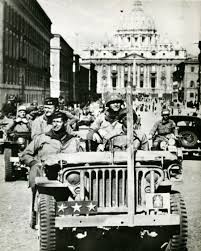
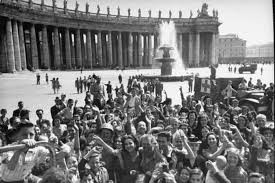

The partisans moved their operations northwards. Mario and Lucia organised their resistance group (GAP) to work with the Americans.
Mario was put in charge of the ‘Dingo Mission’, responsible for the whole of northern Italy. He was the Italian resistance officer linked to the US Secret Service. Mario was parachuted behind enemy lines. His new codename was Dino.
Unfortunately, he was captured by the Nazis. He was incarcerated in a Milan prison but managed to escape.
In April 1945, Mussolini tried to escape from Italy to Switzerland, disguised as a Nazi officer. He was captured by the partisans and taken to Milan.
Mario was sent to collect Mussolini, to bring him back to Rome,
Unfortunately, Mario arrived too late. The partisans had executed the former dictator and his mistress, Clara Petacci. Their bodies were strung upside down in a Milanese garage.

Mario said, that if he had been quicker, he would have tried to prevent the execution, in order to ensure Mussolini stood trial.
Due to his war efforts, Mario received many medals. He was awarded the ‘Silver Medal of Military Valour’ on three separate occasions and also won the ‘War Merit Cross’ three times. He was Italy’s most decorated partisan.
Lucia was also heavily decorated, and the couple used to tease each other about how many medals they had.
As soon as the war was over, Mario married Lucia. Her wedding dress was made from the silk of his parachute.

They were to have three children, Claudia (who went on to work in banking), Giancarlo (a publisher) and Davide (who died in a car accident aged just twenty).
Mario was infuriated when the new Italian government offered an amnesty to all Italian fascists. He felt there should be a reckoning, like the Nuremburg Trials in Germany, so that justice could be served.
Mario then gained a new love of mathematics. He earned a place at ‘La Sapienza’ university in Rome.
He was offered the opportunity to become a Member of Parliament but turned it down. By now, Maths was his chosen career. He specialised in algebra and qualified as a teacher.

From 1964, Mario became involved in Maths research.
Eventually, Mario became Professor of Geometry at Ferrara University, a position he held for twenty-five years before retiring in 1996. He also did a spell working in Montreal and for MIT in Boston.


He was also continually involved in outreach work with children in schools. Mario also wrote many texts and books on the subject. His aim was to engender a love and passion for mathematics throughout Italy.
Mario was full of energy, constantly creating new ideas whilst working on many different projects.
When he retired the University of Ferrara named its Geometry position the ‘Mario Fiorentini Chair’.

Mario and Lucia moved to an apartment overlooking the Trevi Fountain.

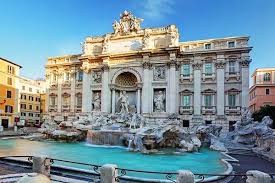
In 2013 there was a documentary in Italy about Mario’s resistance work entitled ‘The Man with Four Names’. In it, he claimed he had had three lives – “Before the war, during it and being a mathematician.”
A subsequent biography about Mario was entitled ‘Three Lives’.


Lucia died in 2015, aged ninety-one. Mario moved to live with his daughter, Claudia, and his grandson.


When Mario turned one hundred, there was a big national celebration with many events taking place, including poetry readings, plays, talks, art exhibitions and maths competitions.


Mario’s final work, ‘Zero One Infinite’ was published the same year.


Three years later, Mario died – still a national hero.

It is believed that Mario was the last surviving witness to the liberation of Rome.
RIPP – Roman Italian Partisan/ Professor


