THE ART OF GETTING LOST SCIENTIFICALLY
Born Stuart Michael Carr in Frome, Somerset, he was always known as ‘Mike’. He had two sisters and an elder brother.
Mike grew up a ‘tearaway’, always breaking rules and running wild. He frequently trespassed on railway lines, seeing how close he could get to speeding trains.
Both Mike’s father and grandfather had been serving soldiers. His father taught him how to shoot, whilst his grandfather instructed him in both astronomy and surveying. Mike built his own theodolite from a boy’s Meccano set.


The family moved to Stone in Staffordshire where his father became the accountant to Joules Brewery. However, Mike never lost his broad Somerset accent.

Mike was extremely tall (6 feet 4 inches), and was given the nickname ‘Lofty’, which stayed with him for the rest of his life. He grew up to weigh fifteen stone.
His mother sent Mike and his brother to a ‘posh’ grammar school to try and civilise them. It didn’t work.
After leaving school, Mike started work as an insurance clerk before training as a surveyor for the pottery industry – and then the Second World War intervened.
Mike signed up to the Staffordshire Yeomanry and was sent to Palestine where he became a navigator. He hated the petty restrictions and rules of army life and frequently clashed with his commanding officer. Mike did not suffer fools gladly.

He was asked to navigate Brigadier John Chrystall through a buffer zone between Syria and Palestine, which he did without incident. Mike said, “I took to navigating easily. I’d trained as a surveyor and was comfortable using a theodolite.”

A few months later, the Brigadier was in conversation with Major Ralph Bagnold, who was setting up a secret military unit for operations behind enemy lines. He was looking for a navigator and the Brigadier recommended Mike – “Get Trooper Carr’.

However, Mike’s commanding officer, Lieutenant-Colonel Gordon Cox-Cox had taken a dislike to Mike and was determined that he would not receive any promotion. He refused to let him leave the Staffordshire Yeomanry.
Major Bagnold was forced to send two Military Policemen to ‘arrest’ Mike, in order to get him away from the Staffordshire regiment.
Bagnold had been a contemporary and friend of Lawrence of Arabia, fighting alongside him in the First World War. He was an expert in desert warfare and one of the few Europeans who had explored the Sahara Desert. Bagnold knew the territory like the back of his hand.


Bagnold’s new unit were to be called the ‘Long Range Patrol’. They began in Egypt in 1940. Very quickly they were renamed as the LRDG – Long Range Desert Group. They were to operate in North Africa against the Italians (and later the Germans), behind enemy lines, sabotaging and destroying – “Raiding and reconnaissance.” Bagnold told his 350 men to forget everything they had learned as a regular soldier. They were now an elite special force.


Each man had his own specialism. Mike was the lead navigator. He knew his skills were vital to any operation and that a slight miscalculation could be catastrophic. They were taught everything that Bagnold knew about desert warfare.


“He called us Bagnold’s Blue-eyed Boys.”
In the desert, Mike used a ‘Sun Compass’, a theodolite designed by Bagnold himself.

Bagnold called Mike’s job, ‘The Art of Getting Lost Scientifically’.
Soon afterwards, the SAS were formed. The SAS has always admired the LRDG as its precursor. Mike said, “The LRDG were the brains, the SAS the brawn.” At one point, the SAS tried to recruit Mike – but he refused.
He loved the LRDG. “To serve the unit was a privilege. The camaraderie was magnificent. We were like a family.”

Mike added, “We were regarded as an undisciplined rabble – but we were not a bunch of thugs. We were composed of selected people who had a particular skill that was needed at the time.”
The only thing Mike wasn’t comfortable with was Major Bagnold’s love of violence – “He loved bumping people off.” Mike grew to love the more cerebral things. He loved the flowers, plant life and the wildlife of the desert.
The men of the LRDG often wore Arab headdresses – but only when being photographed, never on active service.
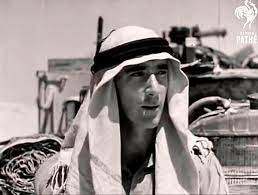

On one mission, the LRDG attacked an Italian convoy. Mike lost the rest of his unit on the retreat so returned to the burnt-out convoy. As he got there, an Italian soldier jumped out of a truck. Mike killed him before he hit the ground.

So well disguised were the LRDG, that whilst out in the desert they were once bombed by three RAF planes. They had to drive for their lives to escape.
The following day, two Luftwaffe planes were above them, but instead of attacking them, they dipped their wings in a friendly salute and flew off.
Later, Mike was navigating a unit towards Jaghbub in extreme heat (hot even for desert conditions) when he collapsed. He came round to a Medical Officer feeding him water and saying, “I have a beautiful sister in Bristol and after the war (if you recover), I’ll introduce you to her.” He recovered – but there never was any introduction.
During another attack on a convoy, Mike got separated from his driver. Not knowing where the other man was, Mike wandered around, lost.
He was rescued by a camp of Senussi – a Muslim political and religious group. They fed him camel’s milk, macaroni and coffee – and dressed Mike as an Arab.

Three days later, enemy soldiers searched the camp. He hid under a pile of Bedouin saddles.
A few days after that, Mike saw six tanks coming towards the camp. He peered at their badges and believed they were the RAF. He went towards them but to his horror realised they were Rommel’s German Afrika Corps (the roundels were very similar). “I remember thinking ‘I didn’t know the British had those (Roundels).” Dressed like an Arab, Mike was able to duck into a tent.


Soon afterwards, an RAF plane crash landed about forty miles from the Senussi camp. Mike went out into the desert to see if there were any survivors.
He found a wounded Australian airman. Mike brought him back to camp, dressed him as an Arab, put him on a donkey and took him to get medical assistance.
Mike’s log for that day says, “Wounded RAF Officer arrived. Goat ate my map.”

The two men passed through enemy lines with no problem. Mike’s disguise was so brilliant that when he got back to British lines, they thought he was a spy.
Mike was bitter about this incident. “I dressed him as an Arab and put him on a donkey and we easily got through the German lines. He would have died within two days if I hadn’t got to him. But years later I read a book about how he found a donkey and returned to safety – but it didn’t mention me.”
Back behind British lines, Mike found Allied forces were using Cecil Beaton as an official war photographer. Beaton took a photo of Mike which shows him at his best – a brooding military machine.


The British attacked the Italian-held port town of Jalo, in Libya. The LRDG travelled through two hundred and fifty miles of desert, navigated by Mike, including taking them over a minefield. They were stopped by an Italian sentry – who Mike shot. However, the shot was heard, and a pitched battle took place.

Mike got separated from his men. He jumped over a wall and hid in a hen house but was eventually captured.
He was bundled into a truck with other prisoners and taken to Benghazi for interrogation.

After this, they were put on a boat and taken to the Italian port of Taranto, where Mike was held for a couple of years.

After the Italians capitulated, and the Germans took over Italy, the Allies invaded Sicily (June 1943) and started to invade the mainland.
The POWs were told they were going to another prisoner-of-war camp in the north. However, the more troublesome prisoners, including Mike, were taken to Poland and put into a barn on a farm. They only had two guards – “halfwits”, Mike called them.
After two days, Mike had had enough. He told his colleagues, “I’m going home”. He kicked a hole in a fence and ran – and nobody came after him. He just kept going.
Mike walked through “A beautiful pine wood – one of the nicest walks I’d ever had.”
He walked for hundreds of miles, living on carrots that he stole from farmer’s fields. For once, Mike had absolutely no idea where he was. (In later years he said he could not even look at carrots).

After walking for what seemed like months, Mike was exhausted and decided to give himself up. He went up to a farmer and said, “I am British.” The farmer merely pointed to a distant church and said, “Americans”.
When Mike got to the church, he found it full of American soldiers. A large GI gave him some soup and Mike started to cry. The GI promptly burst into tears as well.
Mike was flown back to Britain – but he never knew where he had been – and never managed to find out.
When Mike got back to Britain, he weighed just seven stones.
He was given just one week off to recuperate. He went back to his parents. They had been told on three separate occasions that Mike had been killed. On each occasion, his father had carried the telegram to his mother and read the news of his death – and she broke down each time.
This played on Mike’s mind a lot. He began to imagine the same scene in the homes of the German and Italian soldiers that he had killed. It was this vision that turned him into a pacifist after the war.
After his week’s break, Mike was sent to Scotland for more training, prior to rejoining the LRDG. However, the war finished whilst he was still in Scotland, so Mike never saw any more action.
Without Mike, the LRDG had gone on to fight in Yugoslavia, Albania, Greece and Italy.
After the war, Mike became an insurance agent.
He met a primary school teacher, Barbara, and they married in 1960. They bought a house in Oxton, near Birkenhead in the Wirral. They were to live there for sixty years. They had two children.

By 1969, Mike had had enough of insurance. He saw an advert for a three-year non-residential course, to train as a teacher, and he jumped at the chance.
Mike became a fully qualified art teacher. By now, Barbara was a Headteacher, a position she held for two decades.
In retirement, Mike and Barbara became active members of the Oxton Society, throwing themselves into local community activities.


By his own admission, Mike had mellowed and became highly respected in his community. He was a talented artist, potter and wood carver and enjoyed painting wildlife.

Mike would not talk about the terrible things he had seen in wartime. “I am thoroughly ashamed of war and everything to do with it. I can’t believe people behaved like that.”
He would never accept any acclaim. “I was very lucky. I had four million other soldiers helping me, and most of them were engaged in far more dangerous work.”

When respected historian, Gavin Mortimer, wrote a book on the LRDG, Mike’s story was finally told. Mike confided everything to him and Mortimer became a close friend. The book is called ‘The Long Range Desert Group in World War Two’.


The LRDG are largely forgotten now. Mortimer explained, “The LRDG were established before the SAS, and for the wartime generation they were more famous – but they disbanded after the war and the SAS did not.”
Field Marshal Montgomery believed the LRDG were critical to the Allied success in North Africa. He said British operations would have been, “A leap in the dark”, without their work.

Gavin Mortimer said, “In my view, they were more important than the SAS in winning the war in North Africa.”
Aged ninety-nine, as the oldest resident Mike turned on the Christmas lights in Oxton.


By their sixtieth wedding anniversary, Mike and Barbara had lived in the village longer than anyone else.

Mike was the last surviving member of the LRDG. Barbara survives him.


Gavin Mortimer said, “They don’t make them like him anymore – he was one of the greatest.”
RIP – Runaway Italian Prisoner